What Kenya's AI Boom Means for Small Retailers
What Kenya's AI Boom Means for Small Retailers
The Big Picture: AI Is No Longer Just for Tech Companies
On Sunday, Business Daily reported that Kenyan CEOs are racing to adopt artificial intelligence as the country's digital economy reshapes corporate strategy. Across Nairobi's boardrooms, AI is being integrated into banking, insurance, logistics, and retail operations. The conversation has shifted from "should we use AI?" to "how fast can we implement it?" (Source: Business Daily, May 24 2026)
If you run a small duka or sell on Instagram, this might feel distant—something for banks and insurance companies, not for you. But the AI tools these large companies are adopting will change how your suppliers operate, how your customers expect to be served, and how your competitors market themselves. Understanding what is happening now helps you stay ahead.
How AI Is Already Showing Up in Kenyan Retail
You might not notice it, but AI is already in the tools you use every day. When Safaricom's Zuri chatbot answers a customer query, that is AI. When Facebook suggests which of your followers might be interested in your latest shoe drop, that is AI. When M-Pesa flags a transaction as potentially fraudulent and blocks it, that is AI too.
The next wave is more direct. Large retailers like Naivas and Carrefour are using AI to predict what stock they will need based on weather patterns, local events, and historical data. Banks are using AI to decide who qualifies for a business loan—sometimes in minutes instead of weeks. Logistics companies are using AI to plan delivery routes that save fuel and time.
None of this replaces the small retailer. But it does change the landscape you operate in. The question is not whether AI will affect your business. The question is whether you will understand it well enough to adapt.
What This Means for the Instagram Seller
If you sell fashion, shoes, or accessories on Instagram and WhatsApp, AI is already working for you in ways you might not realise. Instagram's algorithm—which decides who sees your posts—is powered by AI. The more you understand how it works, the better you can use it.
Practical ways AI tools can help you right now:
- Product descriptions: Free AI tools like ChatGPT or WhatsApp bots can help you write better captions and product descriptions in seconds. Instead of "Nice red dress size M 2,500," you can generate "Deep red midi dress, soft cotton blend, perfect for Sunday brunch or a casual office day. Available in sizes S-XL. KSh 2,500."
- Customer response templates: AI can draft polite, professional responses to common customer questions—"Is this available?", "Can I get a discount?", "Do you deliver to Mombasa?" Save them as quick replies on WhatsApp Business and cut your typing time in half.
- Content planning: AI tools can suggest what to post and when, based on what has worked for similar businesses. You do not need to guess anymore.
- Price research: Some tools can scan Instagram and Facebook to show you what competitors are charging for similar items, so your pricing stays competitive.
None of this costs more than data bundles. Most basic AI tools are free or have free tiers. The barrier is not money—it is knowing they exist and spending thirty minutes learning to use them.
What This Means for the Duka Owner
If you have a physical shop with employees, AI is coming to your world through your suppliers and your bank—and eventually, through your own operations.
Watch for these changes:
- Supplier relationships: Wholesalers and distributors are starting to use AI to manage inventory. You might notice more accurate stock availability, faster restocking, or automated ordering systems. When your supplier says "we can deliver Tuesday," it might be an AI that calculated the route, not a person with a notebook.
- Banking and credit: Banks using AI can now assess your business for a loan based on your M-Pesa transaction history, not just your bank statements. If you have consistent daily till collections flowing through M-Pesa, AI-powered credit scoring might work in your favour—even without formal financial statements.
- Customer behaviour: As more Kenyans interact with AI-powered services (chatbots, recommendation engines, automated customer support), their expectations for speed and personalisation will rise. A customer who gets instant responses from Safaricom's Zuri will expect the same from your WhatsApp business account.
The Opportunity: AI Lowers the Barrier, It Does Not Raise It
Here is what most people get wrong about AI: they think it gives big companies an even bigger advantage. In some ways, yes—large companies can afford custom AI systems small businesses cannot. But in another, more important way, AI is the great equaliser.
A Nairobi duka owner with a smartphone and a free ChatGPT account can now do things that previously required hiring a marketing person, a copywriter, and a business analyst. You can generate professional product descriptions, plan your monthly promotions, analyse your sales patterns, and draft customer communications—all with tools that cost nothing more than the data to access them.
The CEO at Equity Bank might have a team of data scientists building custom AI. But you can still use the same underlying technology to write better Instagram captions than whatever they are paying their marketing team to produce. The technology itself does not care about the size of your business.
Three Things to Do This Week
- Try a free AI tool for one task. Next time you need to write a product caption or a customer reply, open a free AI tool (ChatGPT, Claude, or even the AI built into WhatsApp Business) and ask it to draft it for you. Compare the result to what you would have written. You might be surprised.
- Check if your bank or mobile money provider offers AI-powered services. Safaricom, KCB, and Equity have all invested in AI. Some features—like faster loan decisions or automated savings suggestions—might already be in your app without you knowing.
- Pay attention to how your suppliers are changing. If your main wholesaler suddenly has an app, or starts sending automated restock alerts, or changes their ordering process—that is AI at work. Understanding the system helps you use it to your advantage.
The AI revolution in Kenya is not about robots replacing shopkeepers. It is about tools that make the smart shopkeeper even smarter. The ones who learn to use them first will have an edge. The ones who ignore them will wonder why business got harder.
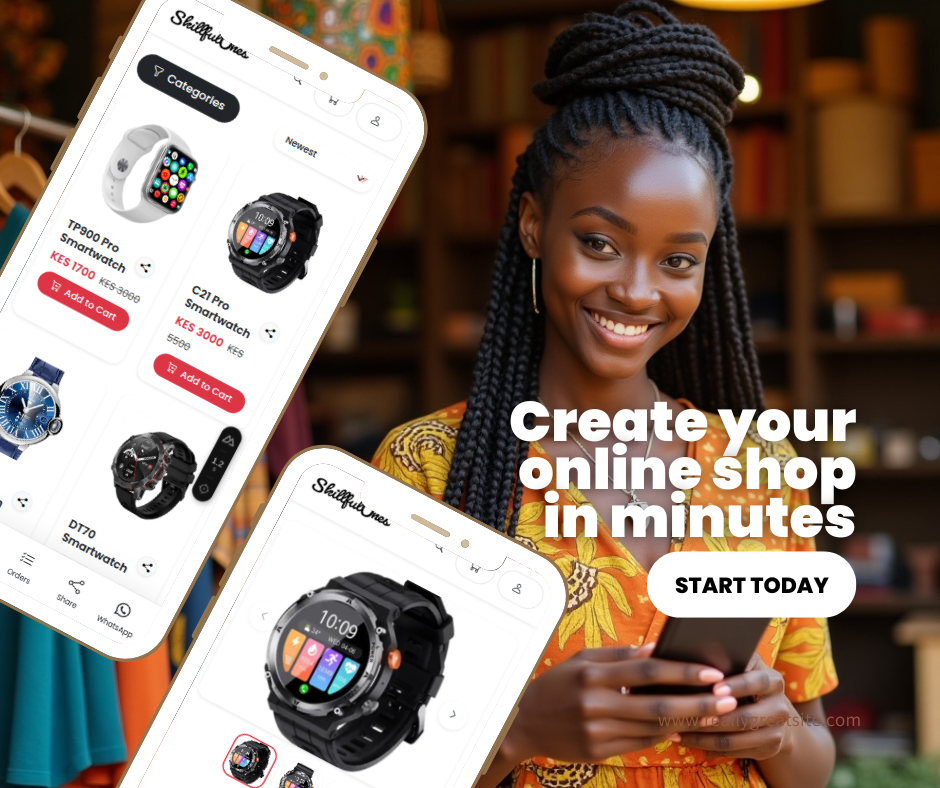
NeoMali gives Kenyan retailers a plug-and-play selling toolkit to automate Instagram and WhatsApp sales with NeoMali GO, or seamlessly sync their physical duka with an online store using NeoMali PRO-DUKA — no technical skills needed.