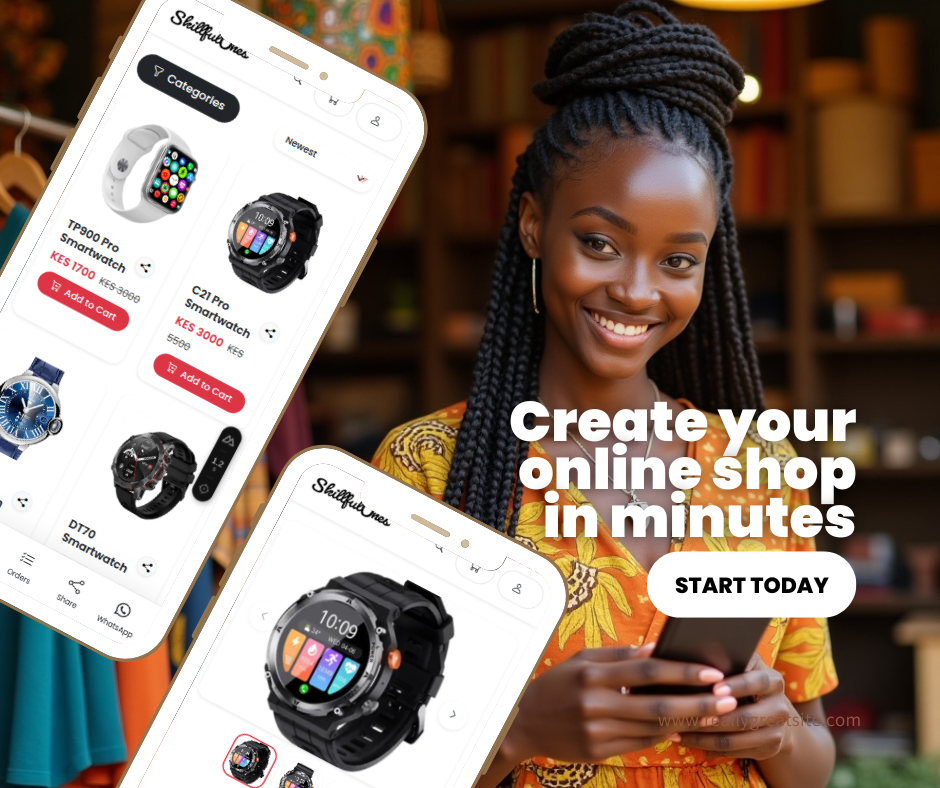
The M-Pesa Moment for Kenyan Ecommerce Is Here — and It Looks Like NeoMali
Kenya changed how the world thinks about mobile money. In 2007, M-Pesa proved that a phone could be a wallet — and suddenly, sending money across Nairobi felt as natural as buying a loaf of bread at your local duka. Today, that same country is on the brink of another quiet revolution. Only this time, the revolution is not about sending money. It is about selling things. And the tool that is making it happen looks a lot like NeoMali.
Payments changed. Selling did not.
M-Pesa solved the problem of moving money. A Kenyan farmer in Nakuru could receive payment for their produce without waiting days for a bank transfer. A mother in Kibera could pay school fees without stepping into a queue. M-Pesa made money mobile before smartphones were universal.
But while payments went digital, selling stayed stuck. The average Kenyan Instagram seller still sends Till numbers manually in a WhatsApp chat. The Eastleigh boutique owner still screenshots every M-Pesa confirmation and pastes it into a group. The Gikomba trader still loses track of what sold online versus what is sitting on the shelf. M-Pesa changed how money moves. It did not change how things get sold.
Until now.
What the M-Pesa moment actually looks like
When M-Pesa launched, skeptics asked: why would I trust a phone with my money? Today, those same skeptics run a digital credit business built on M-Pesa statements. The M-Pesa moment was not about the technology. It was about making something complicated feel obvious.
NeoMali is having that same moment for ecommerce. It is the difference between a seller who says "I sell on Instagram" and a seller who wakes up to three order notifications and has already received the M-Pesa STK Push payment before their morning chai. One is hustle. The other is a business.
For the first time, a Kenyan seller does not need a developer, a credit card, or a computer to have a real online shop. They need a phone and a NeoMali account.
Why Kenyan sellers are ready for this moment
Kenyan sellers were never the problem. The infrastructure was. M-Pesa proved that Kenyan consumers would adopt digital payments at scale — even without a bank account. NeoMali is proving that Kenyan sellers will adopt digital selling infrastructure at scale — even without technical skills.
Consider what is already working:
- A shop owner in Karen whose online store synced with her physical shelf for the first time — no more guessing what sold and what walked out the door
- A Instagram reseller in Kasarani who stopped sending Till numbers manually and started receiving automatic STK Push payments at midnight
- A duka commander in Eastleigh who scouts a second location while his attendant runs the original shop — because the numbers finally add up from anywhere
These are not power users. These are ordinary Kenyan sellers who figured out that there was a better way. And they found it without a manual.
The Till number your online shop always needed
Every physical shop in Kenya has a Till number. You buy something, you tap M-Pesa, money arrives. It is simple. It is trusted. It is how 57 million Kenyans pay.
But for years, selling online meant asking customers to manually enter a Till number, wait, screenshot, and send. That is not a checkout process. That is a relay race. And it breaks at the exact moment you are busiest — 9 PM on a Friday when a customer in Mombasa wants to buy something and your phone has been ringing for an hour.
NeoMali gives your online shop its own Till number. Not a workaround. Not a plugin. A real, automatic, M-Pesa STK Push checkout that works 24 hours a day, 7 days a week. No screenshots. No chasing. Just orders.
Building the ecommerce infrastructure Kenya already paid for
M-Pesa did not invent mobile money — it built the rails on top of what was already there. NeoMali is doing the same thing for ecommerce. It is not asking Kenyan sellers to learn something new. It is giving them the tools that match the way they already work — on WhatsApp, on Instagram, on TikTok, on a phone — and making it seamless.
The M-Pesa moment for Kenyan ecommerce is not coming. It is here. And for the seller who figures it out first, the competitive advantage is not in the product they sell. It is in the system they use to sell it.
Stop hustling. Start operating.